- The first Friends meeting of the year
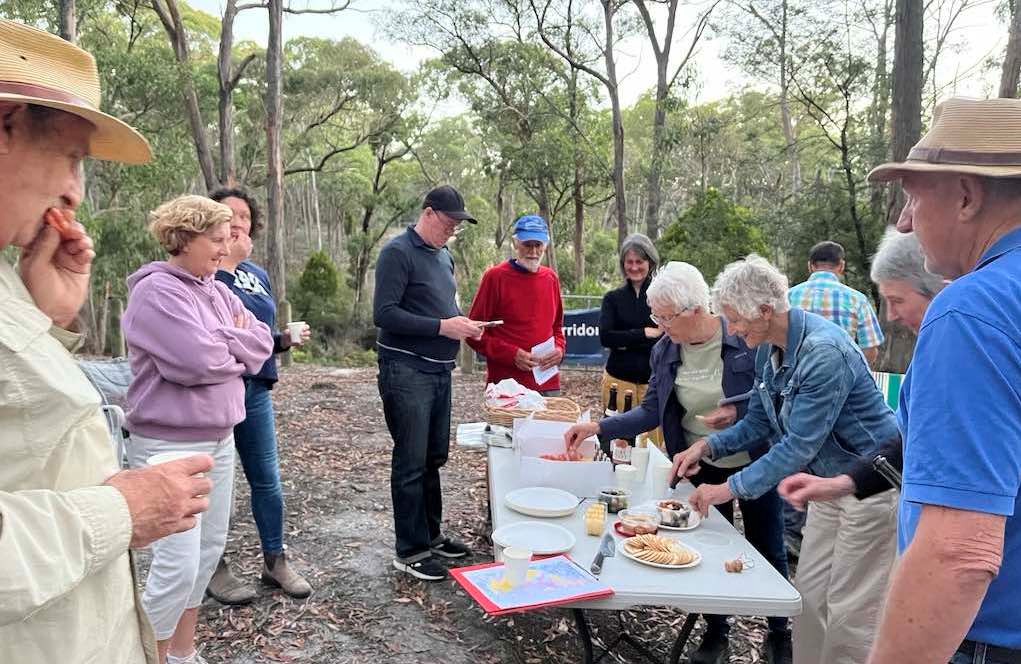
Was held on Wednesday 18th February 2026 at the Gorge adjacent to Olympic Av Mt Clear. Highlight of the meeting was the celebration of the news that the Park had finally been rezoned.
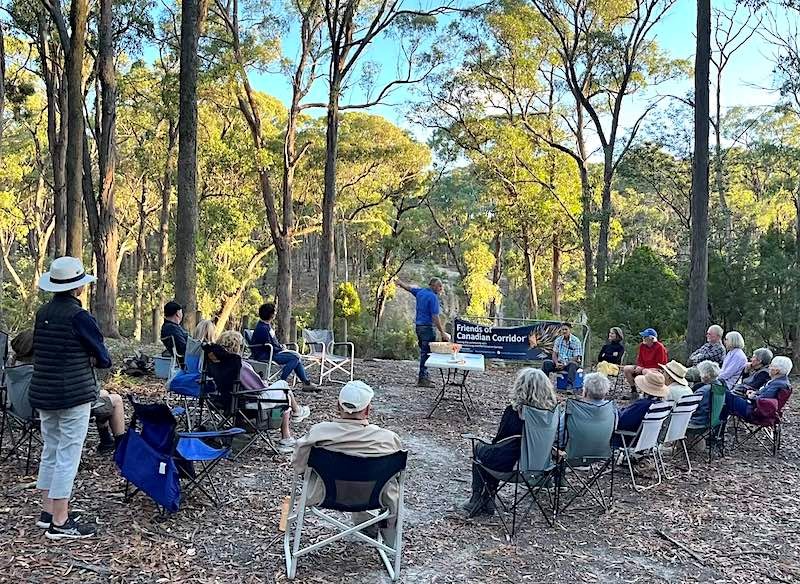
Wednesday 18th February 2026.

Community Bank of Buninyong.

- April Friends meeting
7.00pm Wednesday 29th April, Buninyong Community House,
407 Warrenheip St, Buninyong
Topic “Goldfields Track and Woowookarung Regional Park”
All Members and Friends welcome!

- Woowookarung Park Rezoning
When the Park was established in 2016, the two existing zones were carried over. The Canadian Forest areas were zoned Pubic Conservation and Resource Zone (PCRZ) and the plantation areas were zoned Farm Zone (FZ). Those zones date back to the late 1970’s.
The 2018 WRP Strategic Plan listed rezoning of the Park to all PCRZ as a priority. The Farm Zone is specific in what is allowed, and if it had continued would have precluded the construction of visitor facilities and other necessary works.
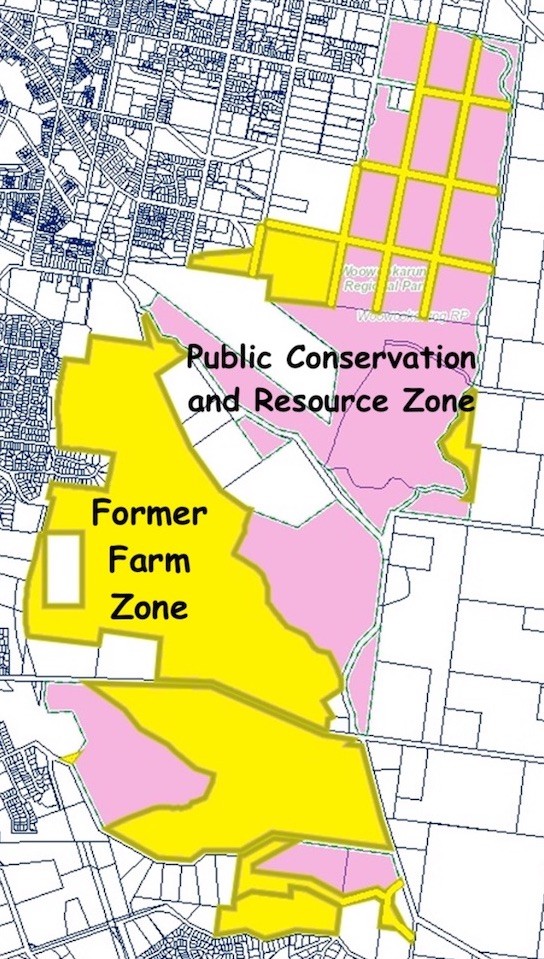
The map shows the two former zones in yellow and pink. Road reserves and superfluous overlays in the Park have now been deleted by the rezoning.
The announcement was made as a “Ballarat Planning Scheme C255 amendment” in the Victorian Government Gazette. Full details at: https://planning-schemes.app.planning.vic.gov.au/All%20schemes/amendments/C255ball?schemeCode=ball

The zoning change is the culmination of over a year’s hard work by Parks Victoria staff in creating and documenting the zoning reasons and changes.
- Smart Living Expo
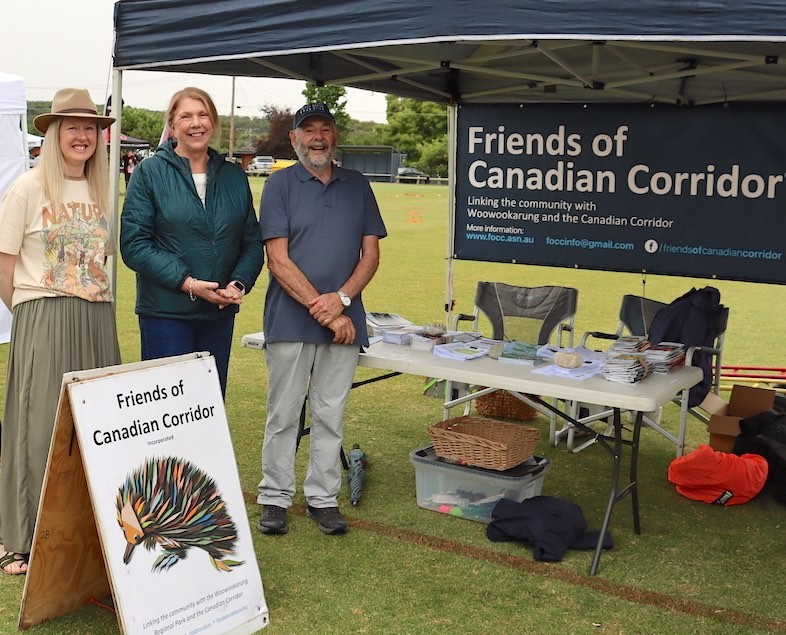
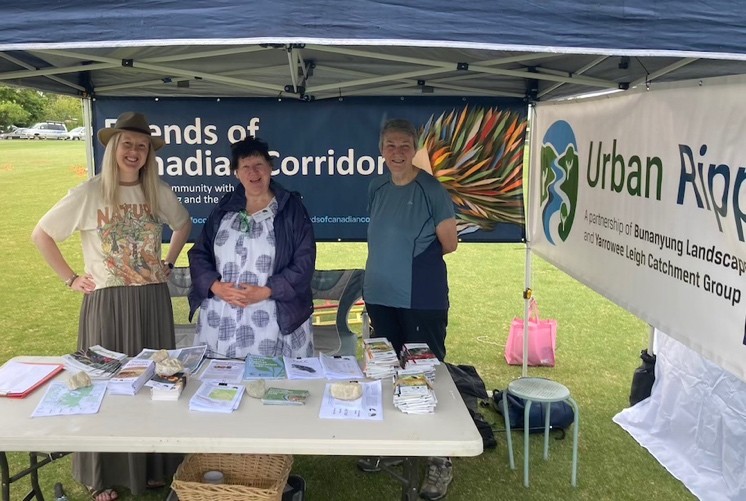
The FoCC hosted a stall at the Smart Living Expo at Buninyong on Sunday 23rd February. Over 400 maps, brochures and flyers were distributed to a large number of expo visitors. Many enquiries were made about the Canadian Corridor and Woowookarung Regional Park and several new “friends” were signed up. The morning session included a visit by local Federal Member Catherine King MP. The FoCC has been at every Expo since 2014 excluding the Covid years.
- Lake Esmond Friends launch
Local Residents from around Lake Esmond met on Saturday morning 21st March 2026, to discuss ideas about how to look after Lake Esmond better. The meeting was facilitated by City of Ballarat, Yarrowee Leigh Catchment Group and the FoCC representatives.
Discussion ranged from:
- short term annoyances,
- park maintenance,
- working bees and future plantings,
- propagation of plants,
- grants
- creating a Lake Master Plan
The meeting agreed for a small group of local volunteers to meet and work out the purpose, identity and the next steps for the future of the group. People wishing to be involved in the group should contact the lead organiser at present: Contact: frmike@tpg.com.au
The Yarrowee Leigh Catchment Group offered Landcare Facilitator support for the group. The FoCC offered local publicity via its regular “Spikey News” newsletter and Facebook. The City of Ballarat provides support to volunteer groups with materials, guidance from the council’s parks and gardens staff, maintenance and preparatory work plus plants from the community nursery.
Attendees at the meeting hearing from Heath of the CoB. 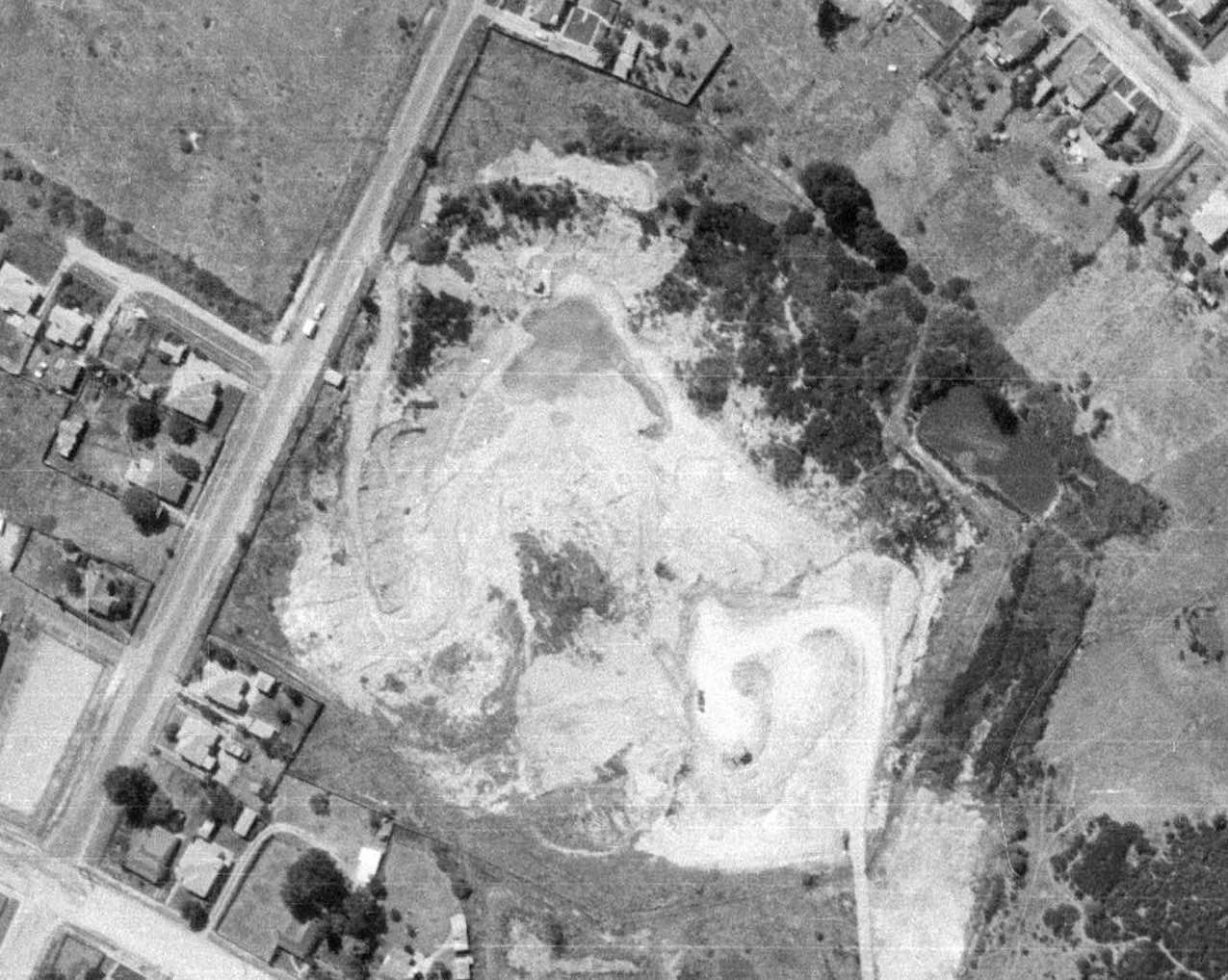
Lake Esmond when it was clay pit in 1970. 
Lake Esmond in 1990 after the establishment of the gardens in 1980’s.
- 10000-Step Trail walk
FoCC walkers tested out the full 10000 Step Trail in Woowookarung Regional Park on Sunday 22nd March 2026. Thirty-seven walkers started at the Dementia Trail welcome shelter and walked around the trail visiting the Lookout, Grasstree Nature Trail, Amphitheatre, Baileys Track, Bunny Rail Trail, Penny Leaf Track returning via the newly completed open section of track between Dozed Track and the Dementia Trail car park.



The 7.8 km long 10000 Step Trail will soon have the bridge over the creek due to be installed in a few weeks’ time with eleven direction signs to be installed before it is officially opened. Great to have an early look at a project that has been ten years in the making.
- FoCC membership for 2026 reminder
Over 143 already paid. A new record!
One unidentified payment
One wonderful FoCC member has paid via Bank First on the 12th February and forgot to add their name. We don’t know who you are.???? Contact foccinfo@gmail.com
Membership of the FoCC helps the FoCC in its advocacy, education and activities in support of the corridor. Membership runs from 1st January to 31st December each year, Membership fee is $20 per year. Children of members are free.
To renew your membership:
- You can pay for membership via Trybooking at: https://www.trybooking.com/events/landing/1427368
Cost is $20.50 via Trybooking. You can also make a donation of any size via this process.
or via Bank transfer: Bendigo Bank Buninyong BSB 633 000 Account No 184147098 Note: Please add your name to the bank transfer and email foccinfo@gmail.com your name and the date of the transaction. If your postal address has changed, please let us know.
New Members: New members are most welcome:
Applications after July are credited to the next year. Membership forms are available online or email foccinfo@gmail.com
- Koala Sightings
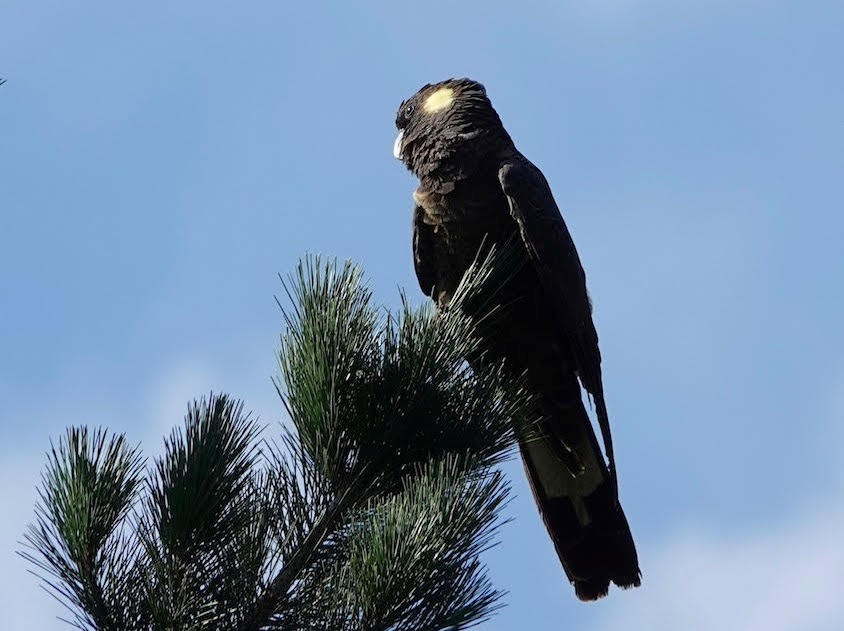
October to March is Koala breeding season and peak sightings time. If you see, hear or find scat from a Koala, please send the information containing the when, where, and how to: foccinfo@gmail.com. Images are gold (even if a little blurry). All Koala sightings are entered into the iNaturalist online data base. The complete list of sightings can be viewed at https://www.focc.asn.au/koalas/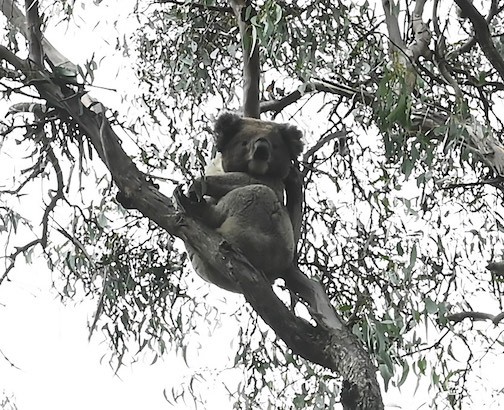
West end of Woodwards Rd Warrenheip. 13th February 2026 Image courtesy of P Nagel 
Koala at Mt Buninyong 16th February 2026. Image courtesy of Mary-Therese 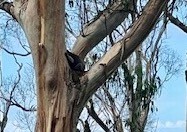
Koala at Mt Buninyong 27th February 2026. Image courtesy of Mary-Therese 
Koala 14th March 2026 cnr of Dozed Track and Horwood Av. Image courtesy of Rob. 
Koala cnr Lofven and Duggan St Nerrina.. “First Koala in area for 30 years” 23rd March 2026. Image passed on by Gareth - Koala Monitoring walk completed
The Moorabool Catchment Landcare Group has been monitoring koalas in Ballarat and Moorabool over the past three years as part of the National Koala Monitoring Program (NKMP). The FoCC have been proud partners on the program.
For the last 3 years, a Koala monitoring walk has been held annually along the Canadian Creek Trail between Hocking Av and Recreation Rd, Mt Clear. On Friday 20th February 2026, volunteers walked with Jackson from the Moorabool Landcare Group looking for Koalas. Alas no sightings. It is important in Koala monitoring to record where they are not seen as well as where they are.
Sound recorders
Placing sound recorders is another Koala monitoring task in likely Koala habitat. Last year a sound recorder was placed in Lal Lal Drain area which resulted in 108 recordings from a couple of Koalas.

- The Koala DNA new research
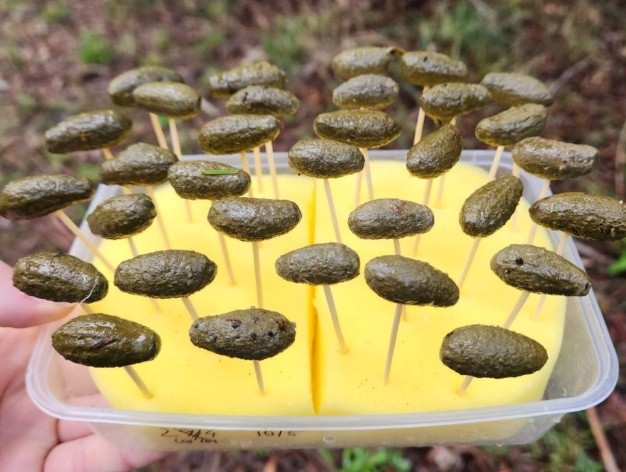
A recent report in “The Conversation” about the surprise findings of DNA of Koalas is worth reading. The Koala DNA question about whether small colonies of Koalas in places like Ballarat were at risk, has a surprise finding, which is heartening for Ballarat’s Koala future. The FoCC believes Koala scat collected from Ballarat in 2023 was included in the research.
Read the KOALA DNA report at:
- Bird of the Season XLIX (February / March 2026)
Black Kite (Milvus migrans)
If raptors (birds of prey) are at the worst of times symbols of grace, aerialist ability, and formidable predatory prowess – then add to that, for this particular raptor, resourceful adaptability, (almost) worldwide occupation, and some Cleopatra charm (more on that later!). And don’t forget its chocolate-coloured plumage, and its being shrouded in lore as one of a few Aussie ‘firehawks’. The Black Kite, formerly and colloquially referred to as Fork-tailed Kite, is Australia’s only raptor with a conspicuously concave (V-shaped) trailing edge to its tail. While they are commonly recognised as open country regulars, the species is seemingly increasingly commonly-encountered in a variety of habitat contexts – including flyovers above the forests of Union Jack Reserve (Buninyong) and Canadian sections of Woowookarung Regional Park. On balance, these birds are awe-inspiring with a hint of mildly villainous protagonist (loveable antihero?)!
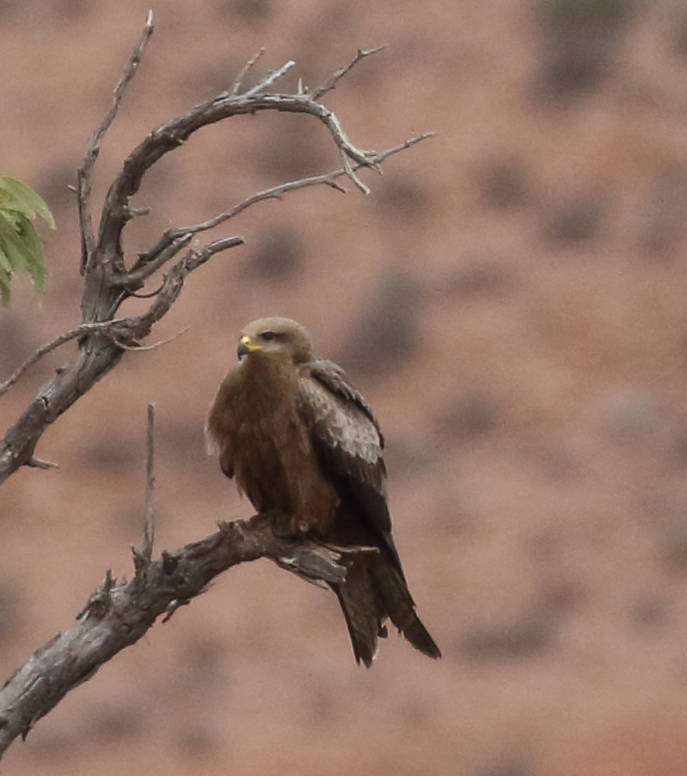
A member of Order Accipitriformes, and the second such featured as a Bird of the Month (after the Wedge-tailed Eagle), the Black Kite is one of six Australian species who go by the ‘Kite’ moniker. Those six ‘Kites’ belong to four different genera (Black Kite is the standalone representative of Genus Milvus, in Australia), and four of them occur in Ballarat (Whistling, Square-tailed, and Black-shouldered are the other three locally-occurring species). Just as there is much diversity between the ‘Kites’, there is much diversity within the Family Accipitridae, given eagles, buzzards, harriers, hawks, and indeed kites, all belong in the family***. And much diversity within the species complex of Black Kite, given several subspecies exist across multiple continents.
| ***Did you know? In listing off the generic names of raptors within Family Accipitridae, the omission of falcons was not an accident or mistake. Falcons belong to their own branch of the evolutionary tree, that of Order Falconiformes, and are actually closer in genetic relationship to parrots and cockatoos (Order Psittaciformes) than they are to the eagles, hawks, kites, etc. of Order Accipitriformes. Kestrel, Hobby, and the Crested Caracara of the Americas, all belong to Family Falconidae, while the former two join Peregrine and other falcons in Genus Falco – demonstrating again that there exists much diversity in some cases within a genus, let alone family or order classification. Other omissions: § Osprey o Rare or absent from Victoria, colloquially referred to as ‘Fish Hawk’, the coastal specialist, piscivore joins Black Kite in Order Accipitriformes, but is in its own offshoot that is Family Pandionidae. § Owls o The nocturnal predators, which are sometimes included in the generic, informal grouping of ‘raptor’, belong to Order Strigiformes, which includes: § Family Tytonidae (the ‘Barn’ owls of Genus Tyto), characterised by their distinctive facial disk § Family Strigidae (the ‘Hawk-owls’ / Boobooks and allies, of Genus Ninox among other genera), whose facial disks are more of an eye mask |
The Black Kite is a medium-sized (48-55cm long, with 1.2m wingspan) raptor, with a largely unpatterned plumage. The ‘Black’ is somewhat of a misnomer, given these kites are more chocolate-coloured, and barely reach dusky brown levels of darkness. This becomes all the more misapplied in females of advanced age, whose head becomes progressively paler (such cases aside, the sexes are largely indistinguishable). Given the largely uniformly brown plumage can be non-descript and not provide many ID clues when distinguishing from other raptors and even the similarly-sized Little Raven, it is very useful for the observer to focus their attention on the bird’s shape. The tail is distinctively forked in a V-shape – setting it apart from all other Australian raptors – and only when it is in moult or the tail is fanned to the extreme does its tail become comparable to that of Square-tailed Kite (but at such an extreme fanning the Square-tailed Kite’s tail is gently convex, whereas Black’s is triangular).
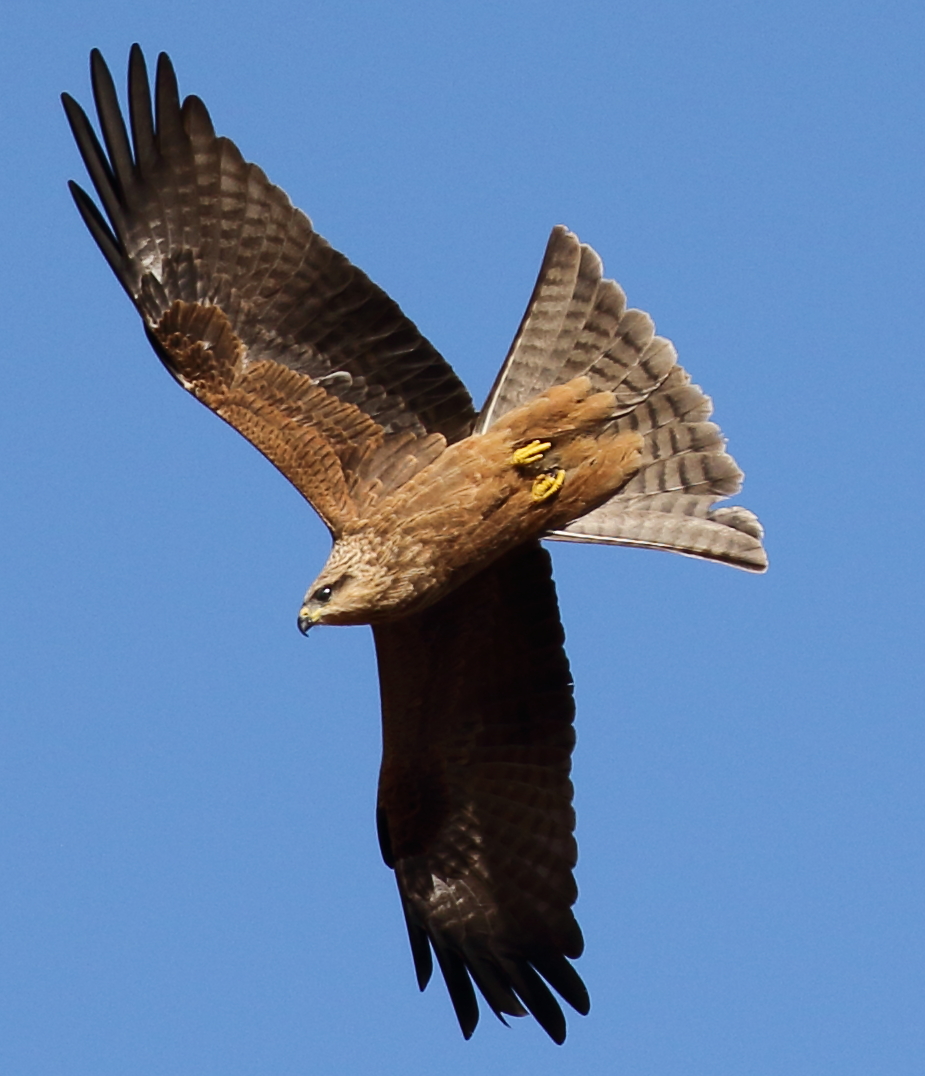
Also important is its wing posture and flight behaviour; gliding on gently bowed wings (like a seagull stick figure in a generic seaside painting) with wrist forward and primaries / ‘fingers’ spread, and tail tilting (clockwise and anticlockwise) – all classic characteristics of Black Kite. For photographers tossing up the ID of a well-defined image, Black Kite is unmistakable with its yellow cere (nostril area), yellow feet, and “Egyptian mascara” through the eye – a descriptor that was trending on Facebook bird identification forums (hence the Cleopatra reference in the intro!).
Black Kites are very flexible and cunning in their foraging strategy, able to combine active predation of locusts, mice, and other small fauna, with scavenging of carrion from roadsides, abattoirs, stockyards, rubbish tips, and beaches. Black Kites are attracted to bushfires, and will survey about the smoky blaze ready to opportunistically seize prey fleeing the flames. This association with fire is so shrouded in lore – and recently verified to be factual – that Black Kite, along with Whistling Kite and Brown Falcon, earned the moniker of ‘firehawks’, i.e. raptors that purposefully spread pre-existing fires by picking up sticks with burning embers and dropping them in nearby unburned patches. To the best of my knowledge, this behaviour is uncommon, and known only from remote northern Australia.
Black Kites inhabit grasslands, open farmland, woodland, scrub, gibber deserts, wooded watercourses, mudflats, mangroves, beaches, airfields, and homestead environs.
Black Kites’ breeding season in the south of Australia is generally July through December (whereas, northern Australian birds may breed at any time of year). Both sexes engage in a ritualised aerial courtship, which entails loud calling and choreography of locking talons and tumbling or cartwheeling. The nest site is often high in the upper canopy of a watercourse tree, where the species may nest singularly or in loose colonies. The female incubates for 35 days the clutch of 2-3 eggs, while the male provides food. The nest is a shallow, untidy dish of large sticks, lined with various debris, such as leaves, grass, bark, wool, and dung. Black Kites often reuse the nest of corvids and other raptors. The species is assumed to breed in Ballarat and district, but irrefutable proof of breeding activity has – at the time of writing – been surprisingly elusive.
Black Kite dispersion (i.e. social organisation) differs from many other raptors. Where many raptors are solitary predators, the Black Kite (and Whistling Kite) are often gregarious, meaning they are “rarely solitary” but instead often occur in small groups. It is also not uncommon for the species to gather in groups totalling hundreds and even thousands of Black Kites!
Vocalisations include stuttering trills, peevish mews and whinnies, and tremulous whistles of “see-err”. Also, plaintive, quavering “kwee-ee-ier” and sharp, staccato “kee-ee-ki-ki-ki”.
The Black Kite is distributed throughout the vast majority of mainland Australia (with the exception of sections of inland WA and SA, while in Tasmania it is a vagrant, i.e. irregular visitor). In its Australian distribution, Black Kites are sedentary (non-migratory), but may be nomadic and irruptive in response to locust and mouse plagues. Black Kites also occupy Africa, Eurasia, and Papua New Guinea, where it is a widespread and familiar species. This multicontinental occupation makes it arguably the most numerous species of raptor in the world.
Next time you wander through Woowookarung RP, Union Jack Reserve, or any of the Corridor’s forest patches bordered by farmland – remember to look up, look twice at ravens in case it’s a raptor that you passed off as a raven, and mind the territorial, mobbing behaviours of magpies – any one of these cues could score you an opportunistic sighting of Black Kite (or other raptor) that you might’ve otherwise missed! And if you see that conspicuously forked tail, you’ll know you’ve been graced by the adaptable, loveable antihero that wears its Cleopatra makeup – what a beauty!
Author note: FoCC Committee member and co-admin of FoCC’s Facebook and webpage, Joel Ellis is the resident bird nerd, amateur Powerful Owl researcher, and editor of FoCC’s (co-funded) ‘Indigenous [Species] of Southern Ballarat’ brochure series. Joel has studied birds up to Honours degree level, is a professional ecological consultant (ornithologist), and member of BirdLife Australia (Ballarat branch).
- Park Works
10000 Step Trail works
The final stages of the construction of the 10000-Step Trail is underway between Lavery Avenue and the Dementia Trail Rotunda area. Penny Leaf Track has been upgraded with washaways removed and surface topping applied.


New connecting trail
A new 390m long connecting trail from the corner of Dozed Tk and Katy Ryans Rd to the Dementia Trail has now been constructed. The final task is the installation of the bridge over Soapys Creek over the next few weeks.
South Gate (Bakers Rd) tree trimming

Preparatory works have been underway at the car park area beside the south gate on Bakers Rd. The car park area is to be formalised with nose in parking, better signage and a reduction in the hard clay surface area.
- Urban Ripple 2026 program.
FoCC community Tree Plantings for 2026.
- 28th June – Canadian Creek
- 12th July – Dozed Track
- 19th July – Lal Lal Drain
- 2nd August – Canadian Creek
- 16th August – Sailors Gully Creek
- 23rd August – Soapy’s Dam
2026 Tree, shrub and grass orders.
The FoCC has ordered 6500 trees shrubs and grasses for planting on the four selected sites. 4500 plants have been ordered from the Wadawurrung Indigenous Nursery at Bostok and 2000 from Wine Barrel Banksias Nursery Buninyong for delivery in June. 20000 tree guard stakes have been ordered from local supplier Ross St Building Supplies.
Urban Ripple – City of Ballarat walkover
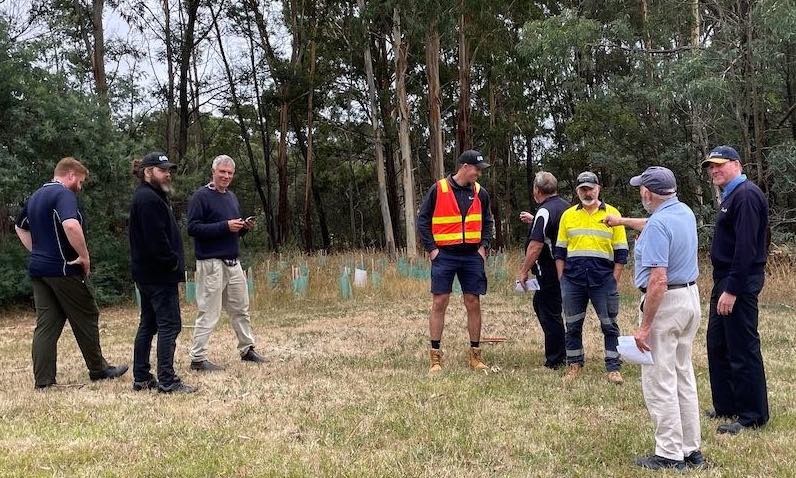
City of Ballarat Parks and Gardens staff met with FoCC reps to finalise the Urban Ripple planting plans.
- Brewery Tap Rd Intersection upgrade
Planning for the upgrade of the brewery Tap intersection at Warrenheip has begun with community consultation. The FoCC has long had a view that an upgrade presents an ideal opportunity to connect north and south of the highway with a shared walk/cycle crossing over the highway. Plus, extensive revegetation beside highway where the Biolink crosses the highway. Ropeways for small animals and poles for gliding animal and birds. The FoCC made a submission to the Brewery Tap Rd upgrade on 8th March 2026.

The FoCC map of trail connections across the Western Highway. After the submission the FoCC received the following message from the Highway Project Team
Dear Jeff
Thank you for sharing the Friends of Canadian Corridor’s (FoCC) submission to the Western Freeway and Brewery Tap Intersection Upgrade consultation.
We appreciate the time and consideration that went into your feedback. Your submission has been provided to the project team for review alongside all consultation inputs.
In particular, we’ve noted FoCC’s suggestions regarding the opportunity to enhance the biolink across the highway and a north–south active transport connection via a shared walk/cycle path.
These points will be considered as we progress design development.
If you have any further suggestions, please don’t hesitate to reach out. We will keep you updated as the project moves forward.
Kind regards
The Project Team
Victorian Infrastructure Delivery Authority
- orest Fire Management York St Burn
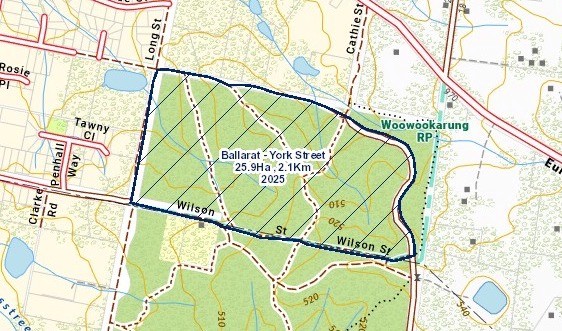
FFM map of planned burn area. 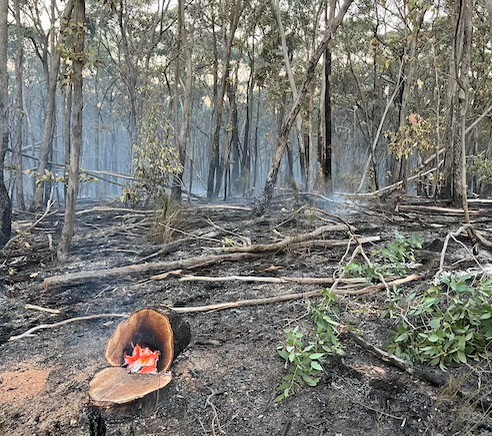
Aftermath of the burn. The burn was mild with only the understorey burning and the tree canopies largely unaffected. - Brown Hill subdivision outcome
Last year the FoCC objected to a proposal to clear a substantial lot of Koala habitat at 76 Springs Rd Brown Hill. Recently the FoCC received the following letter from the Cities statutory planning team upholding our objection.
Dear Sir/Madam,
Re: PLP/2021/788 76 Springs Road, BROWN HILL
The Statutory Planning Unit has considered the above application and determined to refuse to grant a planning permit. The attached copy of the Notice of Refusal to Grant a Planning Permit sets out the grounds of refusal. Your attention is drawn to the appeal provisions, printed at the end of this Notice. Please call 5320 5640 if you have any enquiries.
Thank you
Statutory Planning Team
The FoCC main objection was that the project proposal breached Koala Plan of Management requirements, particularly the retention of Koala Habitat. Well done, City of Ballarat!
- Union Jack Reserve walk
The FoCC is holding a discovery walk around Union Jack Reserve on:
1pm Saturday 18th April 2026
Distance 5.2 km
Meet at reserve entrance, Elizabeth St, Buninyong
Trail Condition – The trail is on formed trails and undulating bush tracks with occasional steep hills.
The walk takes between 2 – 2.5hours and requires reasonable fitness.
Solid footwear, rain and wind proof clothing is essential. Recommended to carry water and any other personal needs. There are no facilities along the way. Cuppa at the end.

- A Goat on Water Reserve land
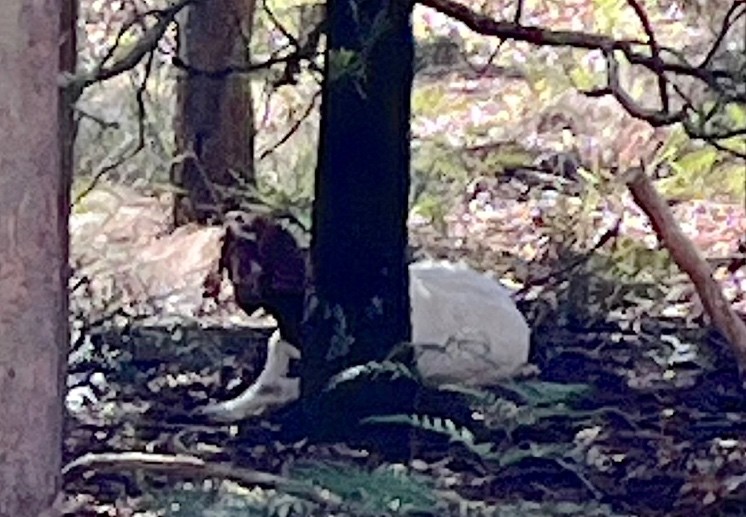
A goat appears to have made its home in the forest adjacent to the Central Highlands Water basin at the corner of Wilson St and Boundary Rd Canadian. It appears to be undisturbed by people, which suggests it may be a domesticated goat. If anyone knows anything about this goat, they should contact City of Ballarat animal shelter services.
- Rubbish dumpers, thieves and vandals
The FoCC urges Park friends to report vandals as well as rubbish dumpers, wood thieves and other suspicious activity to Parks Victoria on 13 1963 or email: woowookarung@parks.vic.gov.au
In emergency situations please call 000. If an offender is spotted, please note vehicle registration details as vehicle identification is most helpful, plus location and details. All information is treated by Parks Victoria Rangers professionally and confidentially.
- Useful information
Parks Victoria Woowookarung email address: woowookarung@parks.vic.gov.au
- City of Ballarat wildlife information:
https://www.ballarat.vic.gov.au/me/pets-and-animals/wildlife
- Recommended Wildlife rescue: Wildlife Victoria (03) 8400 7300
- Koala spotting – https://www.focc.asn.au/koalas/
- Ballarat Wildlife Hospital: https://ballaratwildlifehospital.org.au
- DEECA wildlife issues reporting information
Report wildlife crime to Crime Stoppers Victoria on 1800 333 000. Report any wildlife at immediate risk of deliberate harm or neglect to 136 186. Other matters relating to wildlife and wildlife management should use the 136 186 too. The Help for Injured Wildlife tool will help you locate and contact the closest relevant wildlife carers and rescue and rehabilitation organisations to help the injured wildlife.
- Membership
Membership runs from 1st January to 31st December each year, Membership fee is $20 per year. New members and renewals after July 1 are credited to the next year.
-
- You can pay for membership via Trybooking at: https://www.trybooking.com/events/landing/1427368
Cost is $20.50 via Trybooking. You can also make a donation of any size via this process.
- You can pay for membership via Trybooking at: https://www.trybooking.com/events/landing/1427368
- Bank transfer to details: Bendigo Bank Buninyong BSB 633 000 Account No 184147098
Note: Please add your name to the bank transfer and email foccinfo@gmail.com your name and the date of the transaction. If your postal address has changed, please let us know.
- Payment to the Treasurer at a FoCC meeting
- FoCC Facebook and webpage
www.facebook.com/friendsofcanadiancorridor/
Rob is overseeing the webpage webmaster@focc.asn.au
The FoCC has over 1400+ friends following us on Facebook and growing. Welcome to all new friends. Feel free to pass on to other friends and press the Like button.
- 2026 Calendar
The calendar is prepared by the FoCC committee.

- FoCC Committee for 2026 is as follows:
| President | Jeff Rootes |
| Secretary | Hayley Inglis |
| Treasurer | Peter Darveniza |
| Committee members. | Jo Kelly, Tarn Kruger, Joan Brick, Rob Loveband, Jane Thompson, Bob Hartmann, Tracie Currie and Joel Ellis |
Spikey News change of issue dates
Spikey news is now be published six times a year for the Friends of Canadian Corridor Incorporated. Registered No A0097535B.
The FoCC is an independent Landcare group registered with Landcare Victoria Inc.
Each edition aligns with one of the six seasons which reflect how the Wadawurrung people and the seasonal changes in the landscape interact.
| Season | Spikey issue date |
| Mid-summer | End of January |
| Late summer | End of March |
| Autumn early winter | End of May |
| Deep winter | End of July |
| Early Spring | End of September |
| Spring and Early summer | End of November |